
Investing where growth meets scarcity.
A long term framework for understanding where economic value may concentrate, and for waiting until conviction and price align.
Abstract
The best long term opportunities tend to emerge where structural growth, scarcity, technological change, and capital intensity intersect. My objective is not to predict every market move. It is to identify the direction of value creation, understand the constraints beneath it, and remain disciplined about valuation, liquidity, and risk.
Core view
Economic value tends to concentrate around durable demand, difficult constraints, and advantages that strengthen over time.
I study major economic and technological transitions early, identify where bottlenecks or defensible positions are forming, and remain patient when valuations or market conditions are unattractive.
This framework is directional rather than predictive. The goal is to understand where value is likely to accrue, then wait for a sensible opportunity to participate.
The investment lens
Four forces shape the quality and duration of an opportunity.
- Structural growth
- A market capable of becoming substantially larger over a long period.
- Scarcity
- Supply that cannot respond quickly when demand accelerates.
- Technological change
- A transition that alters cost structures, behavior, or competitive advantage.
- Capital intensity
- Physical and financial requirements that make new supply slow and expensive.
Technology and networks
Technology creates demand. Infrastructure and distribution determine who can satisfy and monetize it.
Artificial intelligence
AI is becoming a foundational economic layer. The opportunity extends beyond model builders to the infrastructure supporting them: compute, memory, networking, energy, data centers, semiconductor manufacturing, and communications.
Software demand can scale quickly while physical infrastructure cannot. That mismatch can create pricing power, higher utilization, and operating leverage.
Platforms and distribution
Companies with broad distribution, proprietary data, strong cash generation, and existing customer relationships can fund significant AI investment and monetize it through advertising, personalization, productivity, acquisition, automation, and software margins.
Digital networks
Monetary networks should be evaluated through scarcity, decentralization, and security. Application networks should be judged through users, transactions, developer activity, stablecoins, payments, tokenized assets, and economic throughput.
The central question is where users, developers, liquidity, and activity ultimately concentrate, not which technology arrived first.
Bitcoin’s four year rhythm
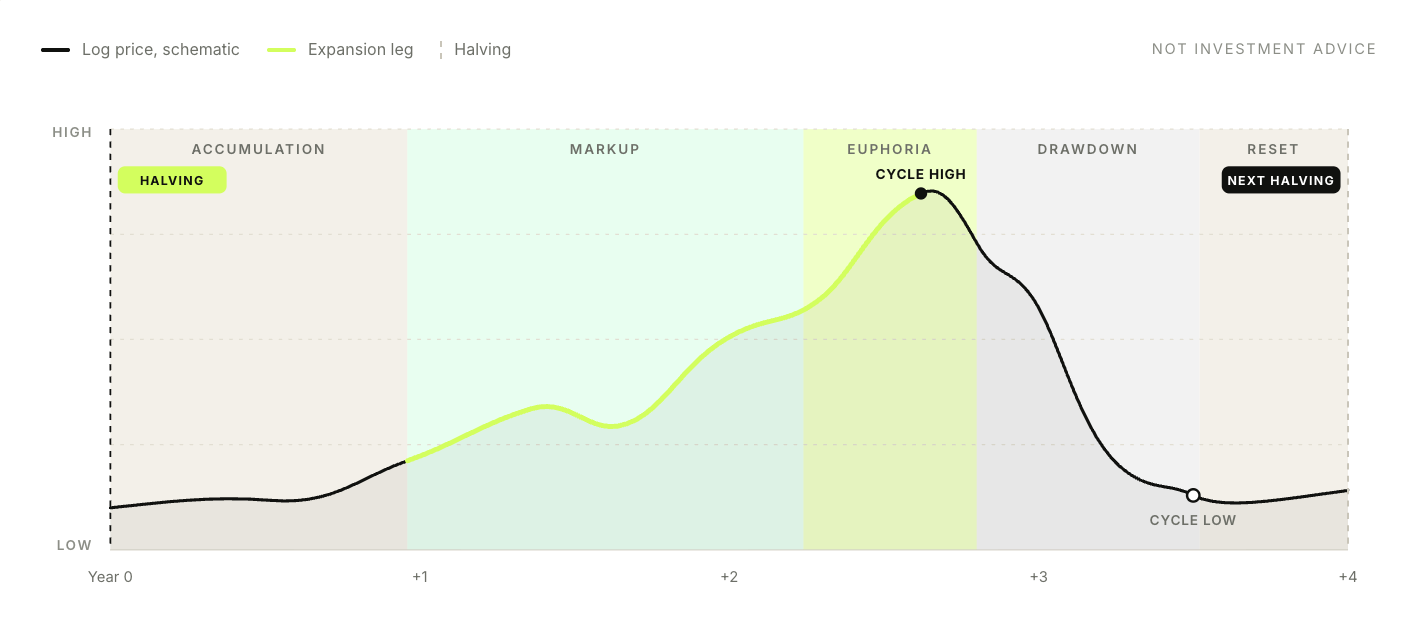
This schematic captures the behavioral sequence I watch around Bitcoin’s issuance cycle: accumulation after a halving, expansion and markup, euphoria, drawdown, and reset ahead of the next halving.
Infrastructure and scarcity
Demand can move in months. Supply may need years.
When demand rises against slow supply, economics can improve for the owners of scarce capacity. The most important constraints may include manufacturing capacity, energy availability, specialized hardware, technological complexity, regulation, and long construction timelines.
Portfolio discipline
A strong idea is not a strong investment at every price.
Valuation
Expected return comes from business quality and entry valuation. It can be rational to remain optimistic about an asset while waiting for a more attractive price.
Liquidity
Cash is more than yield. It is optionality when strong assets become mispriced and other investors are forced to sell.
Concentration
I want to understand many opportunities but concentrate attention where conviction, valuation, and asymmetric upside align.
Risk
I focus on leverage, forced selling, permanent impairment, misunderstood economics, and unreasonable prices, not volatility alone.
Currency and geographic diversification
Wealth should eventually span currencies, jurisdictions, institutions, and regions.
Different economies move through different interest rate cycles, inflation regimes, political environments, and asset price cycles. Geographic diversification reduces dependence on any single monetary or institutional system.
Currencies are economic exposures. I pay attention to rate differentials, central bank policy, capital flows, inflation, fiscal policy, and changes in purchasing power.
Local currency positioning and carry
I prefer to own some of the currencies I expect to spend in, particularly in countries where I return frequently. This can match part of the portfolio to future local expenses. If that currency strengthens against my home currency, it may also preserve or improve local purchasing power; if it weakens, the opposite is true.
Brazil provides a practical example. A CDB is bank issued fixed income, not a government bond, and may pay a fixed rate, a floating rate commonly expressed as a percentage of CDI, or a hybrid return. For someone with recurring expenses in reais, a BRL denominated CDB can pair local currency exposure with local interest income.
This is currency positioning and local carry, not risk free arbitrage. Exchange rate losses can exceed the yield. Issuer credit, liquidity or lockups, taxes, cross border reporting, and eligibility all matter. FGC protection applies only to eligible products and within its current limits.
Primary referencesBrazilian Investor Portal: bank issued securities ↗FGC: current guarantee rules ↗
Selection criteria
The strongest ideas combine several advantages rather than relying on a single narrative.
- Structural growthA market that can become substantially larger.
- ScarcitySupply cannot easily respond to demand.
- Competitive advantageSomething genuinely difficult to replicate.
- Operating leverageRevenue growth can produce disproportionate earnings.
- Network effectsAdditional participants strengthen the platform.
- Long durationThe opportunity can compound for many years.
- Reasonable valuationExpected upside remains meaningfully greater than downside.
Conclusion